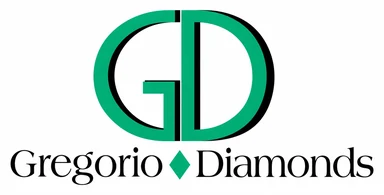
October in Color: Opal & Pink Tourmaline Birthstones
Posted by Gregorio Diamonds on Oct 8th 2026
OCTOBER BIRTHSTONE JOURNAL
An opal catches the light, and a small rainbow appears. A pink tourmaline turns beside it, glowing like the last blush of a South Florida sunset. Together, they give October a beautiful choice: the wonder of shifting color or the warmth of pink.
For a birthday gift, that choice can become wonderfully personal. Perhaps the person you love sees possibility everywhere. Perhaps they make everyone around them feel cared for. A birthstone gives you a way to celebrate both the day they arrived and the qualities you treasure in them.
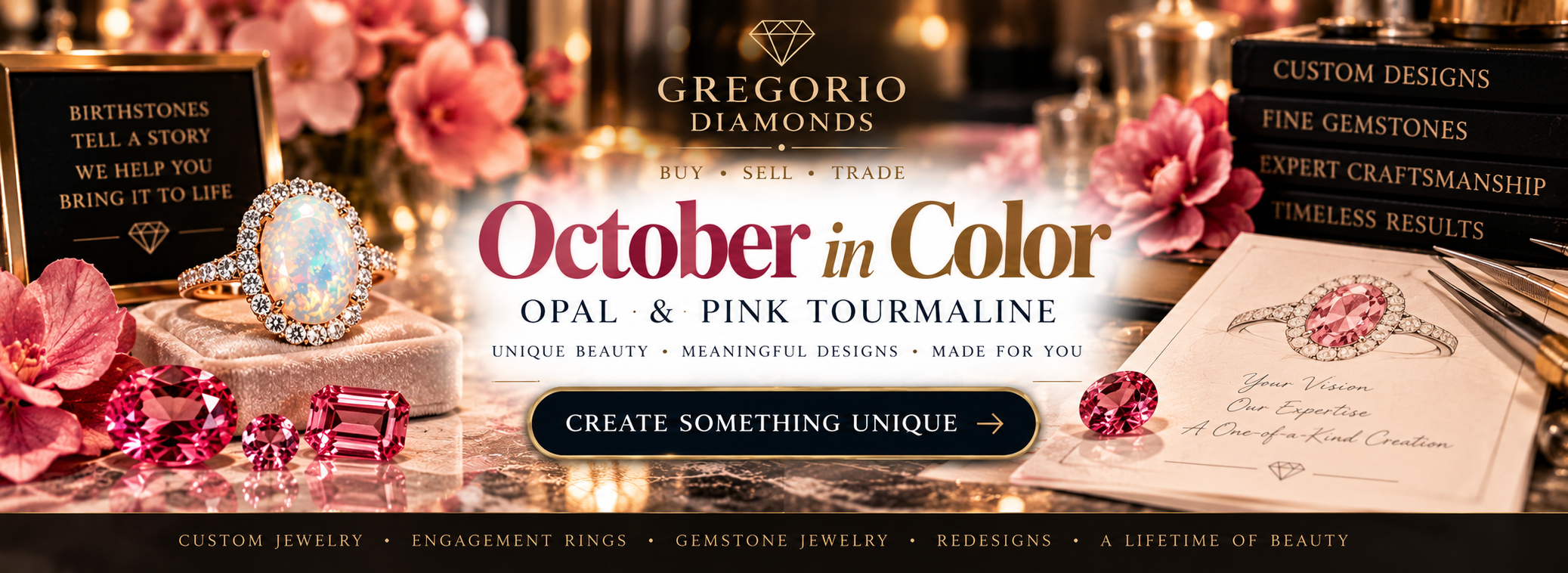
Why does October have two birthstones?
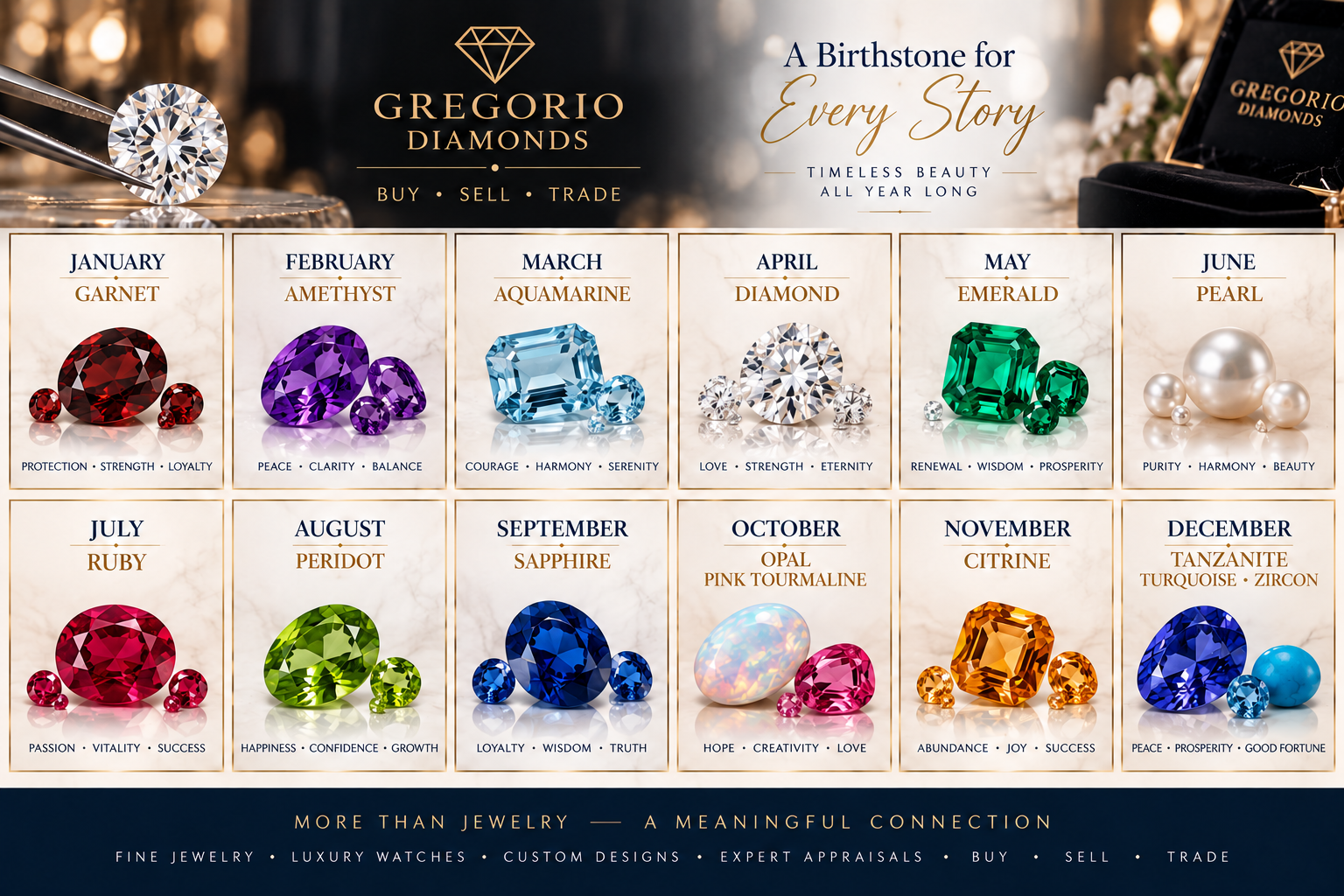
Birthstone traditions developed over centuries, and their lists have changed with place and time. The modern American list was standardized in 1912; the American Gem Society dates tourmaline’s addition for October to 1952. This evolving tradition gives today’s October birthdays more than one way to celebrate.
Opal is October’s traditional birthstone, while tourmaline is its later companion. Tourmaline comes in many colors; pink tourmaline is a particularly appealing choice for a birthday jewel. Its rosy palette offers a different visual experience from opal’s flashes of color.
Both stones celebrate every October birthday, from October 1 through October 31. The modern monthly list does not assign one to the beginning of October and the other to the end. You can choose the stone you love, or bring them together in one meaningful design.
Further reading: American Gem Society: October’s birthstone history.
Opal: a long history of wonder
Ancient names, Roman admiration, and colorful legends
One proposed origin of the name opal is the Sanskrit upala, meaning a precious stone. The Romans used opalus. That language captures an enduring response to this gem: people recognized something extraordinary in a stone that seemed to hold many colors at once.
In the first century CE, the Roman naturalist Pliny the Elder described opal’s remarkable combination of colors, comparing its appearance with other treasured gems. Roman associations with love and hope helped give opal a place in the emotional language of jewelry.
Greek traditions credited opal with prophecy and protection from illness; Arabic legends imagined lightning captured in a stone. Europeans associated it with hope, purity, and truth. These are historical beliefs, not evidence of supernatural or healing powers.
A later chapter brought a different story. Sir Walter Scott’s Anne of Geierstein, published in 1829, helped popularize a superstition about opal and misfortune. The literary association should not discourage a modern admirer: there is no evidence that wearing opal causes bad luck, whatever your birth month.
Further reading: GIA: opal history and lore · GIA: opal’s proposed name origin.
From European mines to the Australian outback
For centuries, European opal history centered on the deposits around Červenica and Dubník, in present-day Slovakia. These gems were historically sold as “Hungarian opal” because the area belonged to the Kingdom of Hungary. Mining became prominent in the sixteenth century and reached a nineteenth-century high point under the Goldschmidt family. The region provides an important bridge between ancient admiration and the modern international gem trade.
Further reading: GIA: the historic Slovak opal deposits.
Australia transformed that trade. Opal was documented near Angaston, South Australia, in 1849, and Australian material reached international markets in the 1890s. Those dates describe the written record and commercial development; they do not establish when the continent’s Indigenous peoples first encountered the stone.
At Lightning Ridge in New South Wales, a landmark came in 1903, when Charlie Nettleton sold a parcel of black opal. Coober Pedy’s opal discovery followed in 1915. The names of these places became part of the language of fine opal, linking a finished jewel with the landscapes and mining communities behind it.
Further reading: GIA: Australian opal history · GIA: Lightning Ridge · South Australian government: Coober Pedy heritage.
The story continues beyond Australia. The discovery of opal near Wegel Tena in Ethiopia’s Wollo region in 2008 brought another important source to the market. Much of this material is hydrophane: porous opal that can absorb water and temporarily change its appearance. Mexico is also known for fire opal, with warm yellow, orange, and red bodycolors. Origin, appearance, and care requirements deserve consideration together.
Further reading: GIA: Ethiopian gem deposits · GIA: Wollo hydrophane opal · GIA: fire opal.
How opal makes its rainbow
Opal is hydrated silica: silica with water in its structure. Unlike a faceted tourmaline crystal, it generally lacks the orderly atomic structure of a conventional crystalline mineral. Its beauty asks us to look at nature on a much smaller scale.
In precious opal, microscopic silica spheres are arranged regularly enough to diffract light, producing the effect called play-of-color. Turn the stone and the colors can change. Common opal lacks this effect, though it can have an attractive bodycolor of its own.
The main varieties help describe what you see. White opal has a light background; black opal has a dark one. Crystal opal is transparent to semitransparent—the trade name refers to its appearance. Boulder opal retains part of its host rock. Fire opal describes a warm bodycolor and does not necessarily display play-of-color. “Fire” and “rainbow” are therefore different features.
Further reading: Australian Museum: opal composition · GIA: opal’s optical effect and varieties.
Pink tourmaline: a gem that found its own identity
A colorful traveler, often mistaken for another stone
Tourmaline’s name comes from a Sinhalese gem-trade term commonly rendered toramalli, associated with mixed gems or mixed colors. That is an apt beginning for a gemstone family whose range of colors long complicated its identification.
In sixteenth-century Brazil, green tourmaline was mistaken for emerald. Red material could pass for ruby. For centuries, the familiar color of another gem sometimes concealed tourmaline’s identity. As mineralogical knowledge developed, its distinctive properties became clearer, and tourmaline earned recognition on its own terms.
Early eighteenth-century European interest also focused on an unusual physical property. Dutch traders brought Sri Lankan tourmaline and reports of its attraction of ash into wider notice around 1703. When heated, tourmaline can develop an electrical charge, a phenomenon called pyroelectricity. This is a measurable material property; it does not demonstrate claims about healing energy.
Further reading: GIA: tourmaline’s name and early history · NASA technical report: historical pyroelectricity research.
American discoveries and an imperial love of pink
In 1820, a tourmaline deposit was discovered at Mount Mica in Paris, Maine. Later in the nineteenth century, gem expert George F. Kunz helped introduce American tourmaline to a broader jewelry audience. Southern California also became an important source, with commercial production at the Himalaya mine beginning in 1898.
Pink and red tourmaline found an especially enthusiastic admirer in China’s Empress Dowager Cixi. Material from California supplied a major Chinese market for jewelry and carvings. Her death in 1908, followed by the fall of the Qing dynasty, brought that period of demand to an end. A rosy gem in a modern pendant carries an intriguing connection with that chapter of international trade.
Today, tourmaline reaches jewelers from Brazil, Afghanistan, Pakistan, and several African countries, among other sources. Maine and California remain significant names in its American history. A stone’s origin can enrich its story, while its individual quality determines how it looks and wears.
Further reading: GIA: American tourmaline and Chinese patronage · Maine Geological Survey: Mount Mica · American Gem Society: tourmaline sources · GIA: California mine history.
What gives pink tourmaline its color?
Tourmaline is a group of related boron-bearing silicate minerals. Most gem tourmaline belongs to the species elbaite, often found in pegmatites, rocks that can grow large mineral crystals. Small differences in chemistry create an extraordinary palette.
Manganese contributes to pink and red hues; radiation-related color centers can also affect some pink material. Pink tourmaline can range from a delicate blush to a saturated rose. The trade term rubellite is used for pink-to-red tourmaline, although sellers differ about where the boundary between pink tourmaline and rubellite belongs.
Some crystals carry more than one color. Watermelon tourmaline, for example, has a pink center and a green outer zone. Its color pattern is another reminder that October’s tourmaline tradition reaches beyond a single shade.
Further reading: GIA: tourmaline chemistry, colors, and varieties.
How do October birthstones reflect a personality?
A birthday gives a gemstone its connection to a month. The wearer gives it a more personal meaning. Birthstones do not scientifically determine or predict personality. Their symbolism can still offer a thoughtful language for celebrating someone you know well.
Opal’s traditional associations with hope, purity, and truth, and pink tourmaline’s associations with love, compassion, and gentleness, provide a starting point. From there, let the person’s own story lead the choice.
FOR THE PERSON WHO SEES POSSIBILITY
Opal
An opal can honor an imaginative friend, an artist, or someone who finds beauty in small discoveries. Its changing colors make a lovely metaphor for a person with many interests and a generous curiosity. Choose it because that imagery feels like them.
FOR THE PERSON WHO BRINGS WARMTH
Pink tourmaline
Pink tourmaline can honor the listener, the encourager, or the loved one whose kindness makes a difference. A soft blush might suit quiet elegance; a stronger pink might suit expressive style. Let their favorite colors and habits guide you.
These ideas are invitations, not labels for everyone born in October. A bold dresser may fall in love with opal, and an adventurous traveler may choose pink tourmaline. If both stones speak to you, a design using both can celebrate imagination and affection together.
To make a gift more personal, add the exact birthday as an engraving, pair the October stone with a loved one’s birthstone, or choose a shape the recipient already enjoys. A handwritten note can carry the meaning: “I chose this opal because you always help me see new possibilities,” or “This pink tourmaline reminds me of the warmth you bring to our family.”
Further reading: GIA: traditional opal symbolism · GIA: pink tourmaline symbolism.
Choosing an October birthday jewel
Start with three questions: What does this person love to wear? How often will they wear it? What would you like the gift to say? Those answers can matter more than a familiar gemstone name or a large carat weight.
| Feature | Opal | Pink tourmaline |
|---|---|---|
| Visual character | Shifting play-of-color in precious opal | Pink bodycolor, often with faceted sparkle |
| Traditional symbolism | Hope, purity, truth | Love, compassion, gentleness |
| Mohs hardness | 5–6.5 | 7–7.5 |
| Design consideration | Protect against scratches and impacts | Greater scratch resistance; still protect against impacts |
| Birthday connection | Every October birthday | Every October birthday |
Look at the individual stone
For opal, consider the brightness and pattern of its color, how it looks as you turn it, its surface condition, and its cut. Ask whether it is solid natural opal, a doublet, a triplet, or a laboratory-grown product. A doublet joins an opal layer to a backing; a triplet adds a transparent cap. These constructions should be clearly disclosed because they affect value and care.
For pink tourmaline, compare hue, tone, saturation, clarity, and the quality of the cut. A very light pink and a deep pink create different impressions. Notice whether the gem remains lively across its face, and ask about inclusions that may affect its durability. Your favorite stone should be appealing in the lighting where you will actually wear it.
Further reading: GIA: assessing opal and assembled stones · GIA: tourmaline quality factors.
Build the design around the wearer
An opal pendant or earrings can give the stone a beautiful setting with less exposure to knocks than a ring. If you prefer an opal ring, discuss a protective setting and how it will fit your daily routine. Pink tourmaline offers more scratch resistance and can suit many ring, pendant, and earring designs, with sensible care.
Yellow gold can bring warmth to opal; white metals can give its colors a crisp frame. Rose gold can echo pink tourmaline’s warmth, while white or yellow gold creates a different contrast. These are design choices to explore together. Bring photographs of favorite pieces, a meaningful date, or simply a color you cannot stop thinking about.
At Gregorio Diamonds, our custom jewelry design service begins with a conversation about your style, inspiration, budget, and how the piece will be worn. An October birthstone can become the center of a new birthday design or part of a family jewel with several meaningful stones.
Caring for opal and pink tourmaline
A gemstone’s hardness describes its resistance to scratching. Toughness describes its resistance to breaking. Those are different properties: a harder stone still needs protection from a sharp impact.
Opal: gentle handling and care tailored to the stone
Opal measures 5–6.5 on the Mohs scale and has very poor to fair toughness. Protect it from knocks, scratching, high heat, and sudden temperature changes. Keep it separate from harder gemstones when stored, and remove it before activities that could strike or abrade it.
GIA recommends warm, soapy water for cleaning opal. Avoid steam and ultrasonic cleaners. Doublets and triplets should not be soaked because prolonged water exposure can weaken their adhesive. Hydrophane opals can absorb liquids, so ask your jeweler for instructions specific to your stone before wet cleaning. Avoid improvised oil or chemical treatments.
Further reading: GIA: opal care · GIA: assembled opal cleaning · GIA research: Wollo hydrophane opal.
Pink tourmaline: durable enough for jewelry, with sensible precautions
Tourmaline measures 7–7.5 on the Mohs scale, with fair toughness. Clean it with warm, soapy water and a soft brush. GIA advises against ultrasonic and steam cleaners. Protect it from high heat, sudden temperature changes, and impacts, and remove rings before strenuous hands-on work.
Ask about treatments for either stone. Opal may be impregnated or modified with smoke or sugar treatments; tourmaline may be heated or irradiated to change its color. A clear description of the stone and its treatment history helps you choose confidently and care for it appropriately.
Further reading: GIA: tourmaline care and treatments · GIA: opal treatments.
A few questions October shoppers often ask
Is pink tourmaline the only October tourmaline?
No. The recognized October birthstone is tourmaline, a gem family with many colors. Pink is a beautiful choice, especially when you want a jewel associated with affection and compassion.
Can someone born in another month wear opal?
Absolutely. Birthstone traditions offer a meaningful connection to a month, and everyone is free to enjoy a stone they love. The idea that opal brings bad luck has no scientific basis.
Which stone is better for a birthday ring?
Pink tourmaline has greater resistance to scratching, while opal requires more attentive wear. The setting, the condition of the individual stone, and the wearer’s habits all matter. Discuss those details with your jeweler before choosing a ring for frequent wear.
Can opal and pink tourmaline be used together?
Yes. A custom pendant, earrings, or carefully planned ring can combine them. The design should account for their different care needs, proportions, and settings so that the finished piece suits the person wearing it.
YOUR NEIGHBORHOOD JEWELER · HIALEAH, FLORIDA
Make October’s colors part of your story
A birthday jewel can hold the color you love, a date you remember, and a message you want someone to keep close. Visit Gregorio Diamonds to explore an October birthstone design with personal guidance from our team.
7664 NW 186th Street · Hialeah, FL 33015
Country Club Shopping Center
(786) 655-0839
History and gemological information are supported by the linked educational resources from the Gemological Institute of America (GIA), the American Gem Society, museums, and other primary sources. Symbolic meanings are cultural interpretations. Jewelry illustrations are for inspiration; individual gemstones and finished designs vary.